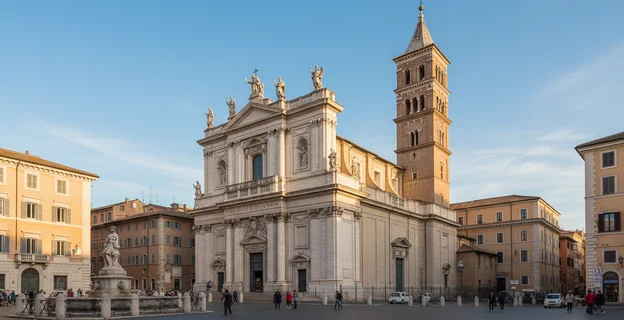
Rome has more than nine hundred churches, and the vast majority of them are free. It is the most underused fact among visitors. People pay to enter museums, wait in line for two hours, and walk past Caravaggios, Michelangelos, and fifth-century mosaics that only need a door pushed open. Roman Catholic heritage is organized around the four major basilicas, but much of what is strongest often sits in secondary churches where there is no one.
In this article you will discover how to structure this exploration, which churches are worth the detour, and why most visitors miss them.
The four major basilicas
These are the four papal basilicas, the heart of Roman Catholic heritage.
| Basilica | What defines it |
|---|---|
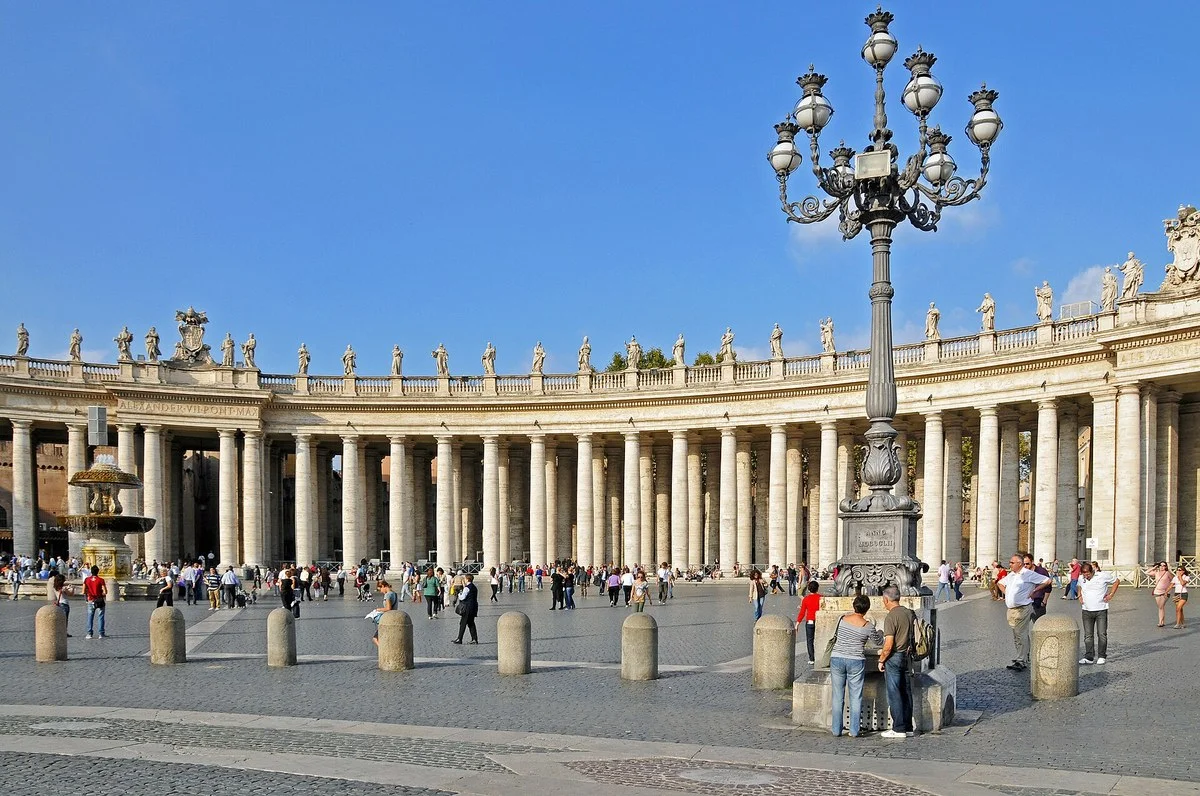
| St. Peter's in the Vatican | The largest church in the world. The Pietà, Bernini's baldachin, Michelangelo's dome |
| St. John Lateran | The cathedral of Rome. The seat of the pope as bishop of the city |
| St. Mary Major | Fifth-century mosaics, among the oldest in Christendom |
| St. Paul Outside the Walls | Built over the tomb attributed to St. Paul. Frieze of portraits of all the popes |
The point almost everyone misses. Rome's cathedral is not St. Peter's; it is St. John Lateran. St. Peter's is a papal basilica, but the pope's episcopal seat is at the Lateran.
The practical consequence is considerable. The Lateran is infinitely quieter than St. Peter's. You enter without a line and sit without being jostled. For anyone seeking a contemplative experience rather than a crowd, the difference changes everything.
Facing the Lateran is the Scala Santa, the Holy Stairs, which pilgrims climb on their knees.
At St. Paul Outside the Walls, look for the frieze that runs under the windows. It carries medallion portraits of every pope since St. Peter. The empty slots left for future popes give the place a strange sense of open time.
Details on St. Peter's are in St. Peter's Basilica, and a structured itinerary is in pilgrimage to Rome.
Free Caravaggios
This is the fact that most surprises visitors, and it is true.
Several of Caravaggio's greatest paintings hang in Roman churches, with free access. Not in a museum, not behind a ticket. In the church, in their original setting, where the painter designed them to be seen.
| Church | Works |
|---|---|
| San Luigi dei Francesi | The St. Matthew cycle, Contarelli Chapel, three canvases |
| Santa Maria del Popolo | The Conversion of St. Paul and the Crucifixion of St. Peter, Cerasi Chapel |
| Sant'Agostino | The Madonna of the Pilgrims |
The three churches are close to one another in the historic center. You can do them all in a morning.
The practical detail that changes everything. These chapels are often in semi-darkness. A coin-operated timer lights the painting for a minute or two. Keep euro coins on you, or you will be looking at a black canvas.
At Santa Maria del Popolo, do not leave without seeing the Chigi Chapel, designed by Raphael. Two giants in the same church, for free.
Churches almost no one visits
San Clemente. Probably the most astonishing church in Rome, and one of the least visited. It reads in three stacked levels. At ground level, a twelfth-century basilica. Below, a fourth-century basilica. And below that, a first-century Roman house with a Mithraic sanctuary.
You literally descend through time, floor by floor. The lower level is paid, and it is one of the rare tickets worth every cent. You can still hear water from an ancient spring flowing.
Santa Maria sopra Minerva. Rome's only Gothic church. It holds Michelangelo's Christ the Redeemer, the tomb of St. Catherine of Siena, and that of Fra Angelico. In front of the church, Bernini's elephant carrying an obelisk.
Santa Prassede. A small church near St. Mary Major, with ninth-century Byzantine mosaics. The Chapel of St. Zeno, entirely covered in golden mosaics, has an intensity nothing prepares you for. It fits in a few square meters.
San Pietro in Vincoli. Michelangelo's Moses is there. The sculpture was part of the tomb of Julius II, a monumental project Michelangelo never finished. You also see the chains that are said to have held St. Peter.
Santa Maria in Trastevere. One of the oldest churches in Rome. Twelfth-century mosaics in the apse. The square in front, in the evening, is one of the liveliest places in the city.
Santa Cecilia in Trastevere. Stefano Maderno's sculpture of the saint shows her exactly in the position in which her body was said to have been found. A haunting work.
The catacombs
Several networks can be visited, mainly on or near the Via Appia Antica, including those of St. Callixtus, St. Sebastian, Domitilla, and Priscilla.
A few points to know.
- Visits are mandatory in guided groups
- It is cool underground, even in midsummer. Bring a jacket
- Lighting is low and passages are narrow
- Photography is generally forbidden
These are not spectacular places in the tourist sense, and that is precisely what makes them powerful. You see early Christian frescoes, still hesitant art made by people inventing a visual vocabulary.
The Via Appia itself is worth walking or cycling. It is one of the oldest Roman roads, and the original paving survives in places.
How to organize the exploration
The mistake is to treat churches like a checklist. Rome has more than nine hundred; the list never ends.
The principle that works: graft churches onto the neighborhoods you are already walking, rather than making dedicated trips.
- Vatican day, add nothing — the day is full
- Ancient Rome day, add San Clemente and San Pietro in Vincoli, both next to the Colosseum
- Historic center day, add San Luigi dei Francesi, Santa Maria del Popolo, Sant'Agostino, and Santa Maria sopra Minerva, all within a pocket handkerchief
- Trastevere day, add Santa Maria and Santa Cecilia
- Dedicated day, the major basilicas and the catacombs
This breakdown appears in the 3-day Rome itinerary.
What to know before you enter
The dress code. Shoulders and knees covered, in every church, including the smallest and emptiest. Enforcement varies by place, but refusal remains possible everywhere. A light scarf in your bag settles the question.
Closing hours. Many Roman churches close for several hours midday, often between noon and 3 or 4 p.m. Build this reflex in, or you hit closed doors in the middle of the afternoon.
Services. Tourist visits are generally suspended during Mass. These are places of worship before they are monuments.
Coins. For chapel lighting timers. Without coins, no light — and therefore no Caravaggio.
Silence. It is requested everywhere, and better respected in secondary churches than in crowded basilicas.
What truly sets Rome apart
No other city in the world offers this density, or this freeness.
A chapel in Rome often holds more art history than an entire museum elsewhere. And you enter by pushing a door, without a ticket, without a line, sometimes without meeting anyone.
That is also why a poorly prepared Roman stay misses it entirely. The big paid sites absorb time and attention, while the most accessible heritage stays invisible for lack of knowing it exists.
Conclusion
Rome's Catholic heritage splits in two. What everyone sees — the great basilicas, the museums, the lines. And what almost no one sees — the secondary churches, free, empty, that often hold the essential.
If you took only one thing from this page, it would be this. Drop one paid museum from your plan and replace it with San Clemente, Santa Prassede, and the three Caravaggio churches. You will see more, pay less, and skip the line.
For the broader context of a stay, see Catholic travel in Italy. For a structured itinerary, pilgrimage to Rome.
Frequently asked questions
- Are Rome’s churches free to enter?
- The vast majority are free, including those that hold masterpieces by Caravaggio, Michelangelo, or Raphael. A few exceptions exist, such as the underground level of San Clemente. Keep euro coins for the timers that light chapels — without light, the paintings stay invisible in the dark.
- Where can you see free Caravaggios in Rome?
- Three churches in the historic center, all close to one another. San Luigi dei Francesi holds the St. Matthew cycle, three canvases in the Contarelli Chapel. Santa Maria del Popolo keeps the Conversion of St. Paul and the Crucifixion of St. Peter. Sant’Agostino holds the Madonna of the Pilgrims. Access is free.
- What is the cathedral of Rome?
- St. John Lateran, not St. Peter’s. St. Peter’s is a papal basilica, but the pope’s episcopal seat as bishop of Rome is at the Lateran. Many visitors spend several days in Rome without ever entering its cathedral, which is far quieter than St. Peter’s.
- Which church to visit if you see only one, besides St. Peter’s?
- San Clemente, near the Colosseum. It reads in three stacked levels: a twelfth-century basilica, a fourth-century one below, and a first-century Roman house with a Mithraic sanctuary at the lowest level. You literally descend through time, and the place remains little visited.