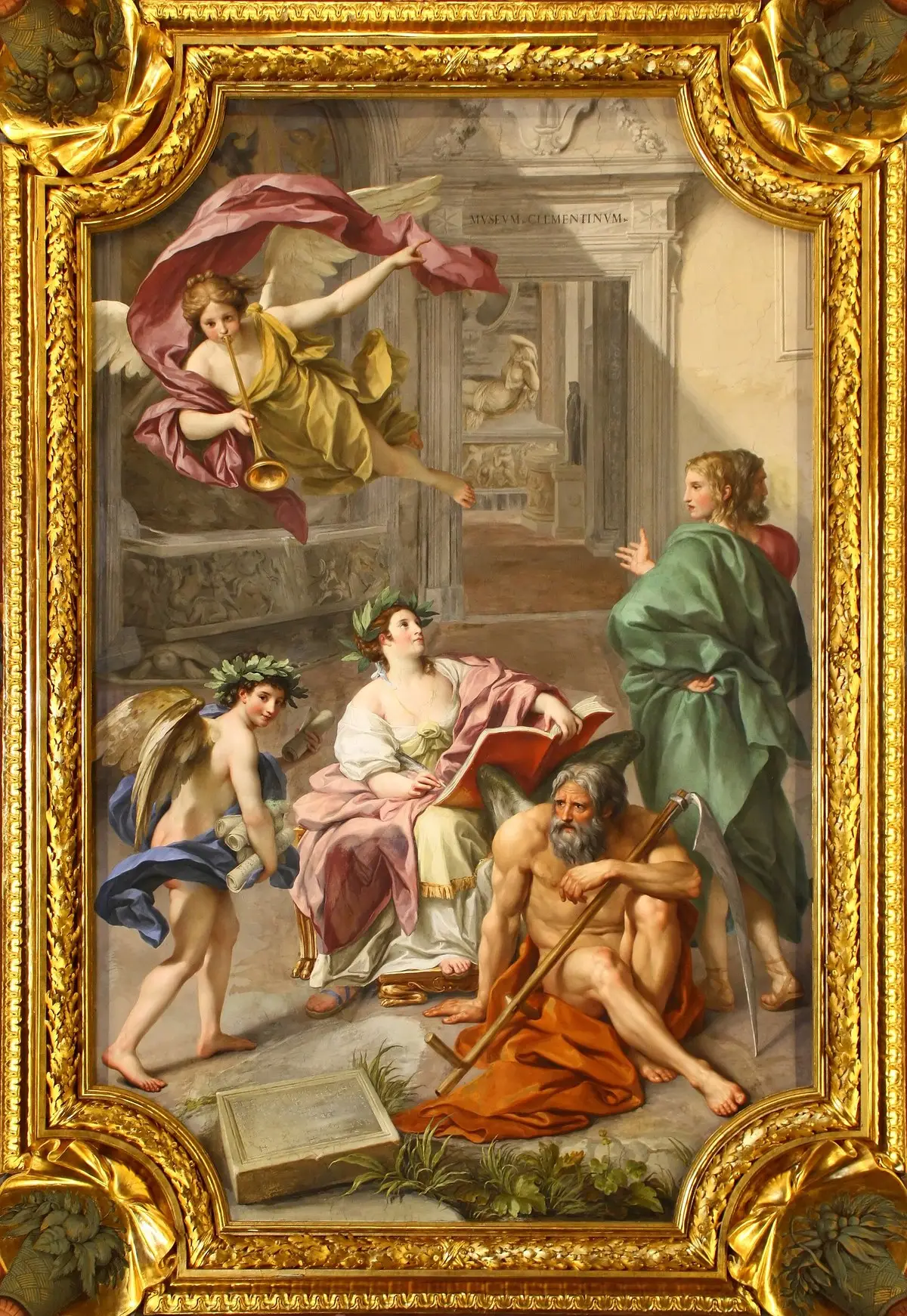
The Vatican Apostolic Library holds about 1.6 million volumes, more than 150,000 manuscripts, 8,300 incunabula, 300,000 coins and medals, and 20,000 works of art. Its reading rooms are not open to the public; they are reserved for accredited researchers who apply with a dossier. A growing share of its holdings, however, can be consulted free online on the DigiVatLib platform, where about 80,000 manuscripts are now available — nearly a third of the collections. The digitization project, begun in 2010, advances at roughly 2,000 manuscripts a year.
In this article you will discover what these holdings actually contain, which pieces made them famous, how digitization works, and what an ordinary visitor can see on site.
What the holdings contain
The collections go far beyond the printed book. They cover manuscripts, coins, prints, and works of art, which makes the Vatican Library as much a museum as a library.
| Type of holding | Approximate volume |
|---|---|
| Ancient and modern volumes | about 1,600,000 |
| Manuscripts and archival documents | more than 150,000 |
| Incunabula, printed before 1501 | about 8,300 |
| Coins and medals | about 300,000 |
| Works of art | about 20,000 |
| Prints and printed documents | about 100,000 |
Figures vary slightly by source and counting method. Some archival holdings are counted by unit, others by item. The order of magnitude, though, stays stable from one source to another.
A distinction that constantly causes confusion
The Vatican Apostolic Library and the Vatican Apostolic Archives are two different institutions. The mix-up is so common that it deserves to be cleared up at the outset.
The library preserves a cultural heritage — manuscripts, printed works, coins, works of art. The archives preserve the acts of Church government, across about 85 kilometers of shelving.
The two were separated in the 17th century. The archives remained closed to outside researchers until 1881, when Leo XIII opened them.
In other words, looking for a document on a papal decision in the library's holdings is simply the wrong address.
The manuscripts that built its reputation
Some pieces are known well beyond specialist circles. What strikes you, looking through them, is the geographic and chronological range of the holdings. The Vatican Library does not preserve only European material, nor only Christian material.
The Codex Vaticanus. One of the oldest known copies of the Bible in Greek. A central piece in New Testament textual criticism.
The Codex Borgia. A pre-Columbian Mesoamerican manuscript, predating the Spanish conquest. Its presence in the Vatican holdings says a great deal about how these collections were built.
The De arte venandi cum avibus. A falconry treatise attributed to Emperor Frederick II. A richly illustrated work of naturalist observation that has nothing religious about it.
The Lorsch Gospels. An illuminated Carolingian manuscript, a witness to the intellectual revival under Charlemagne.
The Gelasian Sacramentary. A Merovingian-era liturgical book, one of the oldest witnesses to the Roman liturgy.
A vellum copy of the Gutenberg Bible. The shift from manuscript to print, preserved in a library that was founded precisely before the printing press.
This diversity explains why the Vatican Library welcomes researchers of every nationality and confession, with no religious requirement.
How the library was built
The story begins with Nicholas V, pope from 1447 to 1455, a scholar and bibliophile. When he arrived, the papal collection held only about 340 manuscripts. He sent emissaries to Germany, Denmark, and Greece to buy everything they could find, and dispatched translators and copyists to the monasteries.
His aim was explicit. He wanted to welcome humanists and scholars, at a time when the printing press did not yet exist in Europe.
It was Sixtus IV who institutionalized the project. On 15 June 1475, the bull Ad decorem militantis Ecclesiae officially created the library. Bartolomeo Platina became its first librarian, and the institution finally received the financial means it had lacked.
Growth was spectacular. Counts show 2,527 manuscripts in 1475, then 3,498 in 1481 — nearly 40% more in six years.
Later centuries each brought their own expansion. Sixtus V charged the architect Domenico Fontana with building a new structure, whose centerpiece is the Salone Sistino. Paul V, Leo XIII, and Pius XI continued the work.
A note on the dates. Some sources retain 1474, others 1475. The gap comes from the distinction between the completion of preparatory work and the date of the bull itself. It is not a contradiction; it is a question of what one chooses to date.
Digitization, an open project since 2010
In 2010, the library began the systematic digitization of its manuscripts. Processed documents are put online free of charge, with no subscription or registration.
Funding. A major share came from the Polonsky Foundation, which enabled a partnership with Oxford's Bodleian Library between 2012 and 2017. That partnership made more than 1.5 million pages from both institutions freely accessible.
Pace. About 2,000 manuscripts digitized per year, or nearly 700,000 pages.
Progress. About 80,000 manuscripts are now available online, roughly a third of the collections. The project is far from finished, but it has crossed the threshold where it becomes genuinely useful.
Priority. The most fragile and most consulted manuscripts were processed first. The dual benefit is clear: the original is protected from handling while access is widened.
What matters is the reversal this represents. A Carolingian manuscript that only a few dozen scholars could once consult can now be read from any screen, free, at any hour.
Using DigiVatLib
The platform is called DigiVatLib. It is free and does not require an account for consultation.
A few landmarks to find your way.
- Manuscripts are identified by their shelfmark, which indicates the original fonds. For example, the Vat. lat. series corresponds to Latin manuscripts in the Vatican fonds
- Keyword search works, but it runs on the catalog records describing the manuscripts, not on the manuscript text itself, which is not transcribed
- Images can be viewed at very high resolution, with a zoom that lets you read illumination details
- Download is available for many items
The limit to understand: this is not a full-text search engine. You find a manuscript if you know what you are looking for, or if you are willing to dig. It is not Google.
The official entry point is on the Vatican Apostolic Library website.
Can you visit the library
This is the most asked question, and the answer often disappoints.
Not freely. The reading rooms are reserved for accredited researchers. Accreditation requires a dossier, a justification of the need to consult the holdings, usually a letter of recommendation from a university or research institution.
This is not an arbitrary exclusion. It is a research library, not a museum, and conservation of the pieces requires limiting handling.
What an ordinary visitor can see. The Vatican Museums itinerary passes through several historic decorated rooms belonging to the library, including the galleries and part of the Salone Sistino. What you see are the rooms themselves — their frescoes and display cases — more than the holdings.
Temporary exhibitions are also organized from time to time, and they are the only opportunity for the general public to see original pieces.
Practical details for visiting the Vatican are covered in visiting the Vatican and Vatican Museums tickets.
The paradox of the Vatican Library
It is worth stating plainly.
It is one of the oldest and most closed libraries in the world. Its rooms remain inaccessible to the public, its accreditation is demanding, and part of its holdings has never been shown.
It is also one of those that have opened their collections most widely over the past fifteen years — free, with no registration, no paywall, and an image quality that many public institutions do not offer.
Five and a half centuries after Sixtus IV's bull, Nicholas V's goal — to welcome scholars — is fulfilled in a way he could not have imagined.
Conclusion
The Vatican Library is not visited; it is consulted. That is the reversal to understand.
For a traveler preparing a stay in Rome, it means that most of what the Vatican Library holds is accessible before you leave, from home. What you see on site are the rooms, not the holdings.
To broaden to the city's religious heritage, see Catholic heritage of Rome. For an overview of the Vatican Library's heritage, see the Apostolic Library heritage.
Frequently asked questions
- Can you visit the Vatican Library?
- Not freely. The reading rooms are reserved for accredited researchers, who must submit a dossier justifying their need to consult the holdings. The general public does, however, access certain historic decorated rooms on the Vatican Museums itinerary, as well as temporary exhibitions organized from time to time.
- Are the manuscripts freely available online?
- Yes. The DigiVatLib platform gives free access, with no registration, to digitized manuscripts. About 80,000 are available — nearly a third of the collections — and the pace is about 2,000 new manuscripts a year. The most fragile and most requested pieces were processed first.
- What is the difference between the Vatican Library and the Apostolic Archives?
- They are two distinct institutions, separated in the 17th century. The library preserves a cultural heritage — manuscripts, printed works, coins, and works of art. The archives preserve the acts of Church government, across about 85 kilometers of shelving. Access for researchers was opened in 1881 by Leo XIII.
- What is the most famous Vatican Library manuscript?
- The Codex Vaticanus, one of the oldest known copies of the Bible in Greek, is probably the most studied. But the holdings also include the Codex Borgia, a pre-Columbian manuscript, a falconry treatise attributed to Frederick II, and a vellum copy of the Gutenberg Bible. The range of the collections goes well beyond the religious.